India Is on the Rise. Why Does the INR Not Reflect That?
In the past decade, India has grown immensely. It now has stable governance, modest levels of inflation, ample foreign reserves, and steady economic growth. However, this upwards trajectory has not been seen in the valuation of the Indian Rupee which has seen record lows in recent days. The conflict between the US and Iran has also taken its toll on the INR. In March 2026, the INR had lost 4% of its value against the USD. For context, the pound and the euro only lost about 1%. This is in addition to the 5% decline following Donald Trump’s tariff announcements last year. These factors have combined to make the INR the weakest performing currency in Asia.
It is now considered inevitable that the INR will hit triple digits against the USD soon enough but why does this devaluation continue to happen when everything else in India seems to be on the ascendancy? In this blog post, I will explain the reasons why the INR, despite India’s massive growth, is still structurally a weak currency and explain how you can capitalize on the nation’s growth while proactively protecting yourself against the continued devaluation of the Rupee.
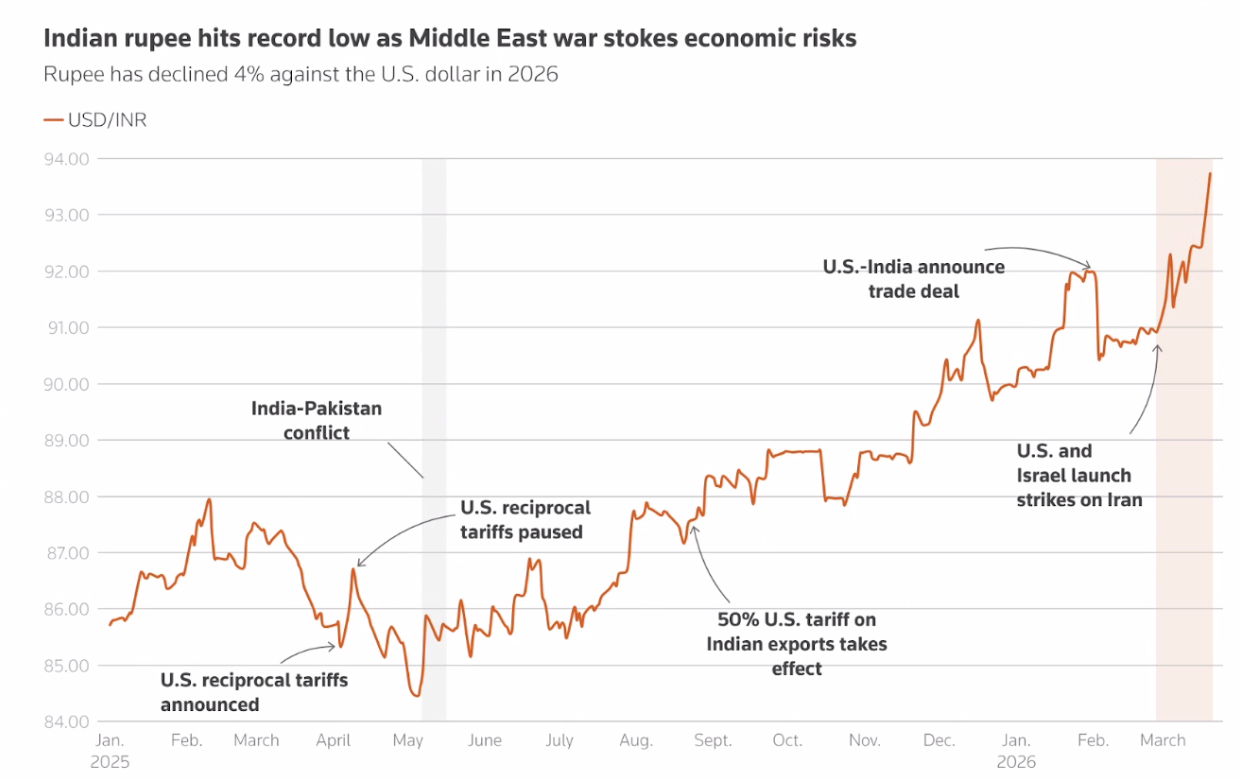
Line chart depicting the dollar-rupee pair's price action
What Are the Factors Driving the Indian Rupee’s Decline?
1. High Import Demand (Structural Trade Deficit)
India runs a persistent current account deficit, meaning it imports more goods and services than it exports. This gap is not cyclical, it’s structural.
A major driver is energy. India imports over 80% of its crude oil needs, and oil is priced globally in U.S. dollars. Every time India buys oil, it must sell rupees and buy dollars, increasing demand for USD and weakening the INR.
Beyond oil, India also imports:
Electronics and semiconductors
Gold
Machinery and industrial inputs
Even when exports grow (IT services, pharmaceuticals, manufacturing), they often don’t scale fast enough to offset rising imports. This creates continuous downward pressure on the rupee, regardless of domestic growth.
2. Foreign Portfolio Investor (FPI) Outflows
India has become a major destination for global capital but much of it is “hot money” (short-term portfolio flows into equities and bonds).
When global conditions such as the following shift, foreign investors tend to pull money out of emerging markets like India:
Higher interest rates in the U.S.
Risk-off sentiment during geopolitical tensions
Better returns in developed markets
This triggers a chain reaction:
FPIs sell Indian assets
They convert INR back to USD
Demand for USD rises sharply
INR depreciates
Even if India’s long-term story is strong, these short-term capital movements can dominate currency trends.
3. Global Geopolitical Tensions & Oil Prices
Geopolitics plays a disproportionately large role in India’s currency due to its import profile.
For example, tensions involving Iran or broader Middle East instability can:
Disrupt oil supply chains
Spike global crude prices
Increase India’s import bill
This has a double impact:
More dollars are needed to pay for costlier oil
Domestic inflation rises, weakening purchasing power
Additionally, in times of global uncertainty, investors flock to safe-haven assets like the U.S. dollar, further strengthening USD against emerging market currencies like INR.
4. Trade Deal Delays & Tariffs
India’s trade relationships, especially with the United States, play a key role in currency stability.
Delays in trade agreements or the imposition of tariffs can:
Reduce export competitiveness
Limit market access for Indian goods
Create uncertainty for global investors
For instance, protectionist policies and tariff announcements under Donald Trump disrupted global trade flows and disproportionately affected emerging markets.
When export growth slows while imports remain strong, the trade deficit widens, putting further pressure on the rupee.
5. Strong U.S. Dollar (Relative Weakness of INR)
Currencies are always relative. Even if India performs well domestically, the rupee can weaken if the U.S. dollar strengthens faster.
The USD remains structurally strong due to:
Its status as the world’s reserve currency
Deep and liquid financial markets
Higher relative interest rates
Even in periods when the dollar softens globally, INR may still weaken against it. This suggests that the issue is not just “dollar strength,” but intrinsic pressures within India’s external balance.
6. Inflation Differential
India typically experiences higher inflation than developed economies like the U.S.
Over time, this erodes the rupee’s purchasing power. According to economic theory (Purchasing Power Parity), currencies with higher inflation tend to depreciate gradually to maintain equilibrium.
So even with “controlled” inflation, if it’s consistently higher than the U.S., the rupee will trend downward over the long term.
7. RBI’s Managed Depreciation Strategy
The Reserve Bank of India does not aim to aggressively strengthen the rupee.
Instead, it follows a managed float:
Intervenes to prevent sharp volatility
Allows gradual depreciation to support exports
A weaker rupee actually helps:
Indian exporters become more competitive globally
IT and services firms earn more in INR terms
This means the rupee’s decline is not always a failure, it can be partly intentional and strategic.
8. Growth Model: Consumption vs Export-Led
Unlike countries such as China, India’s growth has been more domestically driven (consumption-led) rather than export-led.
This has implications:
Strong domestic demand increases imports
Export capacity takes longer to scale
External balances remain weaker
As a result, even high GDP growth doesn’t automatically translate into a stronger currency.
So What Can I Do to Protect Myself and My Investments?
India’s growth story is strong, but the rupee’s structural weakness is likely to persist. Rather than resisting this trend, investors should adapt by diversifying globally, owning assets that benefit from a weaker INR, and avoiding excessive exposure to cash.
Combining Indian growth opportunities with global investments allows you to participate in the country’s rise while protecting your purchasing power. In the long run, success comes not from predicting currency moves, but from building a portfolio that is resilient to them.
If you would like to learn how a diversified investment portfolio can help you fulfil your duty as an Indian while protecting yourself against long term currency depreciation, book a no-strings-attached call with a member of our team today.
